
Agile Planning: 2012 Open Research
 |
This open research into agile planning was performed the last two weeks of January 2012 and there were 149 respondents. The survey was announced on the Agile and Lean Discussion group on LinkedIn, the Agile Project Management group on Yahoogroups, and by me via Twitter. The goal was to find out from agilists how they were addressing planning activities on their projects. |
The Survey Results
Some findings include:
- Figure 1 overviews the importance that agilists think about various agile planning practices. As you can see the results are very positive.
- Figure 2 depicts which initial release planning practices were being followed. The majority of the responses in the “Other” category, you can read the comments by downloading the CSV file below, focused on initial requirements envisioning activities such as identifying initial user stories to populate the backlog. It’s interesting to see how modeling has been subsumed as a planning strategy on agile teams. I’ll have to rework this question next time we run this survey.
- Figure 3 indicates the average amount of time that agile teams spend doing iteration planning. Lean teams would refer to this practice as just in time (JIT) planning.
- Figure 4 shows that roughly two thirds of agile teams do some form of look-ahead planning to give them a head start on planning in a coming iteration.
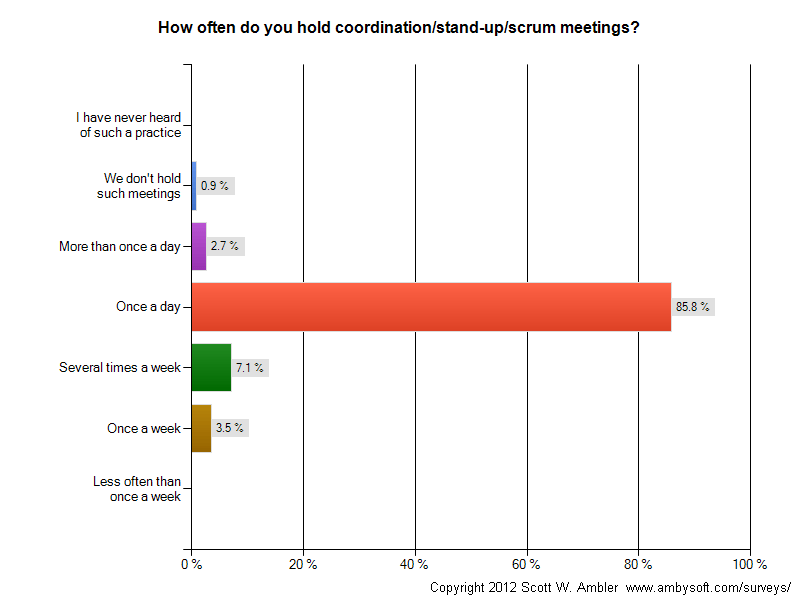
- Figure 5 overviews the frequency of agile teams holding daily coordination (Scrum) meetings.
Figure 1. What is the value of common agile planning practices?

Figure 2. Approach to initial planning on agile projects.

Figure 3. Time spent doing iteration planning.

Figure 4. Adoption rate of look-ahead planning.

Figure 5. The frequency of coordination meetings.
Downloads

|

|

|
What You May Do With This Information
You may use this data as you see fit, but may not sell it in whole or in part. You may publish summaries of the findings, but if you do so you must reference the survey accordingly (include the name and the URL to this page).
Discussion of the Results
- This survey suffers from the fundamental challenges faced by all surveys.
- As I indicated above, I wish I had given options around initial modeling when I asked about initial planning.
- I likely should have worded the iteration planning question to be inclusive of JIT planning that we see on Kanban teams.
- Because the survey was announced on agile lists, there is a clear bias towards organizations doing agile. This was done on purpose. Therefore these figures should not be used to calculate overall adoption of agile techniques.
Why Share This Much Information?
I’m sharing the results, and in particular the source data, of my surveys for several reasons:
- Other people can do a much better job of analysis than I can. If they publish online, I am more than happy to include links to their articles/papers.
- Once I’ve published my column summarizing the data in DDJ, I really don’t have any reason not to share the information.
- Too many traditionalists out there like to use the “where’s the proof” question as an excuse not to adopt agile techniques. By providing some evidence that a wide range of organizations seem to be adopting these techniques maybe we can get them to rethink things a bit.
- I think that it’s a good thing to do and I invite others to do the same.